
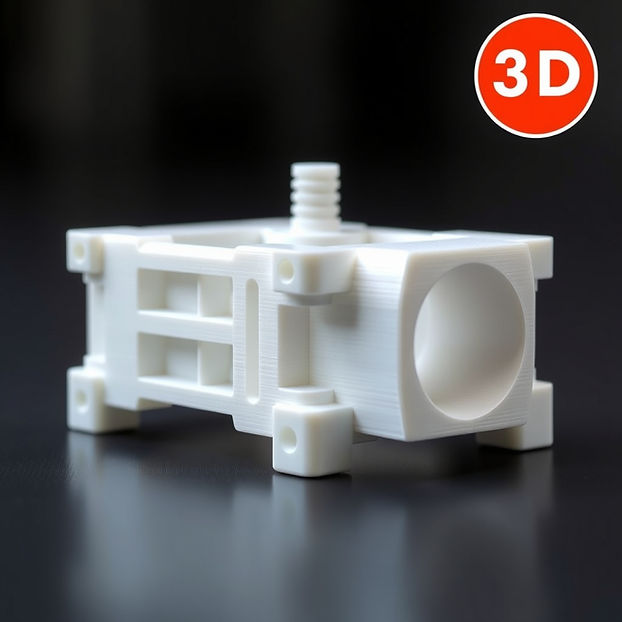
3D PRINTING
BES Packaging Corp offers FDM 3D printing services to support rapid prototyping, custom packaging components, and functional part production. With a 300 mm × 320 mm × 325 mm build volume and access to all common FDM materials (selected to match your strength, flexibility, and temperature needs), we help manufacturers move from concept to physical parts quickly and cost-effectively. Standard lead time is 1–2 weeks, with rush 1–3 business day turnaround available for urgent projects. Contact us today about your project.
FDM 3D PRINTING
What is FDM Printing?
FDM (Fused Deposition Modeling) is a type of 3D printing that builds parts layer-by-layer by melting and extruding a thermoplastic filament through a heated nozzle.
Why Use FDM?
It’s a popular, cost-effective method for creating prototypes and functional parts because it supports many durable materials, offers fast turnaround, and works well for everything from simple fixtures to complex custom components.
What Material Should You Use?
-
PLA (Polylactic Acid): Easiest to print, good surface finish and detail, cost-effective—best for prototypes and display parts (lower heat resistance).
-
PETG: Strong and slightly flexible, good chemical/moisture resistance, more heat-resistant than PLA—great for functional parts and light-duty fixtures.
-
ABS: Tough and impact-resistant, better heat resistance—good for enclosures and functional parts (can warp; typically needs controlled printing conditions).
-
ASA: Similar to ABS but better UV/weather resistance—ideal for outdoor parts and durable housings.
-
Nylon (PA): Very strong, wear-resistant, and flexible with excellent fatigue resistance—great for gears, hinges, and end-use functional parts (often needs dry storage).
-
TPU (Flexible): Rubber-like flexibility and impact resistance—best for gaskets, grips, bumpers, and vibration-damping parts.
-
Polycarbonate (PC): Very high strength and heat resistance—used for demanding functional parts (more challenging to print).
-
Polypropylene (PP): Lightweight, chemical-resistant, and fatigue-resistant (“living hinges”)—useful for containers and snap-fit parts (can be tricky to print).
-
Carbon Fiber–Filled (PLA-CF, PETG-CF, Nylon-CF): Stiffer and stronger with improved dimensional stability—excellent for rigid brackets and tooling (more abrasive; needs hardened nozzle).
-
Glass Fiber–Filled (Nylon-GF, etc.): Strong, heat-resistant, and more stable than standard nylon—good for structural parts (also abrasive).